Showing posts with label Growth. Show all posts

Friday, August 5, 2011

Illinois Tool Works: Innovation, Growth, Above-Average Yield and Low Valuation - Seeking Alpha

Illinois Tool Works: Innovation, Growth, Above-Average Yield and Low Valuation - Seeking Alpha: "This is part seven of a seven-part series that is looking at the incredible opportunity that a cyclical company can represent as earnings recover coming out of a recession. A primary objective of this series is to illustrate that price drops of well-established companies are usually temporary even after earnings are cyclically weak.

Part one, 6 High Profile Industrials With Staggering 3-Year Performance, provided a cursory view of six industrial companies. In the part prior to this one, we looked at Ingersoll-Rand (IR) in Rand: Profit by Investing in Recovering, Large, Well-Entrenched Cyclicals. You can find the entire series here."

Wikio

Saturday, April 23, 2011

Going for Growth (Part 3): Forecasting Future Earnings the Key - Seeking Alpha

Going for Growth (Part 3): Forecasting Future Earnings the Key - Seeking Alpha

Introduction
It is my belief that as investors in common stocks, and whether we are aware of it or not, we are all buying earnings. Because ultimately, long-term investor rewards are going to be a function of two primary factors; the most important of which is the earnings power of the companies invested in. The stronger and faster that a business can grow their profits, the more valuable it becomes to the shareholders. Furthermore, if income is the goal, the level and rate of growth of dividends are also directly tied to earnings growth. The second important factor is valuation. If you find a company with good earnings power, you should do very well over the longer-term, as long as you don't do something foolish like over pay to buy those earnings. This is why I emphatically state, you make your money on the buy side.
When the above principle is applied to my definition of a growth stock, the following dynamic is revealed. If you buy one dollars worth of earnings today, with the expectation of 15% earnings growth, then your future earnings five years out would be two dollars. In other words, at a 15% growth rate it takes approximately 5 years to double your earnings. If you expect 20% growth, then your dollars worth of earnings you bought today will grow to two dollars worth of earnings in just over 3 1/2 years. And if you're lucky or smart enough to find a company capable of growing earnings at 25% per annum, then you will have two dollars worth of earnings in just under three years. The exceptional future returns that can be derived from either of the examples above, is functionally related to the significantly greater earnings power you then possess and achieved over such a short period of time. These examples represent quintessential validation of the phrase - time is money.
A few comments on analyst estimates
In Part 2, I provided several examples of future earnings expectations based on consensus analyst estimates. I have found there to be a lot of confusion and misunderstanding regarding the accuracy and validity of analyst estimates. I believe the problem rests with the manner in which misses and beats are scored. In truth, I feel it is unreasonable to expect future earnings estimates to be too precise. All one should really ask is that the estimates provide a reasonable range of achievable and acceptable probabilities and accuracy. In other words, if the consensus estimate says the company will earn $2.00 per share, and the company reports $1.98 per share, this is generally considered a miss. In my view, the example above was an accurate estimate within a reasonable plus or minus range.
Therefore, I would like to see a study where analyst estimates are scored based on achieving an accuracy rate of plus or minus 5%, then plus or minus 10%, then plus or minus 15% and so on. I believe a study like this would show a significantly higher percentage of accuracy of analyst estimates than most studies currently suggest. However, the real point I'm trying to make is, that although I believe analyst estimates are more accurate than most people give them credit for; I also believe that they only represent a good starting point prior to a more comprehensive research effort. In other words, the analyst estimates offer a great screening function, but before I will lay my money down, I need to validate their expectations in my own mind.
Forecasting Future Earnings is the Key
As investors, I believe we cannot escape the obligation to forecast; our future results depend on it. However, our forecasts should not be mere prophecy or simple guessing. We should not play hunches, instead, we should attempt to calculate reasonable probabilities based on all the factual information that we can assemble. Even then we should acknowledge and understand that the best we can do is develop forecasts that will fall within a reasonable range of probabilities. My objective is to use analytical methods that provide me reasons to believe that the relationships that have produced earnings growth in the past will persist in the future to a level high enough to satisfy my definition of a growth stock. As Warren Buffett so eloquently once put it, "It is better to be approximately right than precisely wrong."
Most importantly, forecasting is a process and the actual act itself can vary significantly from company to company and industry to industry. Therefore, I can only provide concepts and generalizations of the forecasting process that I personally use. Complete books can, and perhaps should, be written on this important subject and vital component of what I consider true investing to be all about. With that said, there are no shortcuts. Whether you are buying growth stocks or dividend paying stocks, or any other investment, you need to have some rational and, hopefully, reasonable expectation of the future. That can only be accomplished, and must be accomplished, by a forecasting process. Therefore, what follows is offered as a general overview and a few simplistic examples of how forecasting future earnings can be approached and accomplished.
I typically approach the forecasting process from both a macro and micro evaluation. With a macro perspective I focus on what I believe are obvious areas that offer major future investment opportunities. For example, a study and analysis of demographics can be quite useful. In the United States, and throughout much of the rest of the world, there currently exists a bi-modal distribution of our population. Here at home this is often referred to as the "Graying of America" and the "baby boomer" generation. A study of the consumption tendencies of these and other demographic segments can allow you to make informed decisions as to the future health of several industries that will serve these large and growing markets. Healthcare and financial services focused on providing retirement benefits are two obvious examples that come to mind. You may have noticed that several of our examples in Part 2 were healthcare related.
Although there are numerous opportunities in healthcare, forecasting the future potential of a pharmaceutical or biotech company is a straightforward but often precarious process. The logical place to start is by evaluating the company's current portfolio of drug candidates in their pipeline, and where they are in the various stages of regulatory filing. Personally, when I do this, I place most of my emphasis on drug candidates in phase 3, and less emphasis on drug candidates in phase 1 or 2. The majority of phase 1 candidates actually fail. In contrast, the majority of drug candidates in phase 3 usually make it to the marketplace. Therefore, it's simply a matter of attempting to calculate the sales potential and/or blockbuster status of pending candidates. Although this is difficult to do with great precision, it can be done accurately enough that a reasonable estimate can be made.
Technological advancements and other scientific breakthroughs can provide a fertile ground of potential business opportunities. The current explosion in “smartphones” and other similar technology devices represent powerful and compelling areas of growth. Of course, the Internet has spawned numerous game changing industries and companies in which to explore. There are many young and very fast-growing companies that have resulted from these breakthroughs that are rapidly becoming household names and concepts. Google (GOOG), Netflix (NFLX), Priceline (PCLN), and many others too numerous to list, are examples of businesses that didn't even exist a decade or two ago. But I caution to not overpay, and to do the work necessary to understand the business to include the competition.
Another example growth industry could be new and dynamic restaurant concepts. Companies like Starbucks (SBUX), Panera Bread Co. (PNRA) and Buffalo Wild Wings (BWLD) are just a sampling of many that have enjoyed recent success. With this type of company, forecasting the future can be as simple as evaluating how many units have penetrated how many markets, and then trying to determine what type of future growth potential remains. The same analysis would apply to companies like Decker’s Outdoor (DECK), Coach (COH), Kohl’s (KSS) and other companies in the retail or luxury goods space. Although I could go on and on, hopefully I have made my point. Forecasting is a process that needs to be approached as comprehensively as possible, but with expectations regarding precision kept within reasonable probabilities.
(Follow this link for a dynamic video of these true growth stocks.)
Challenges and Pitfalls of Forecasting
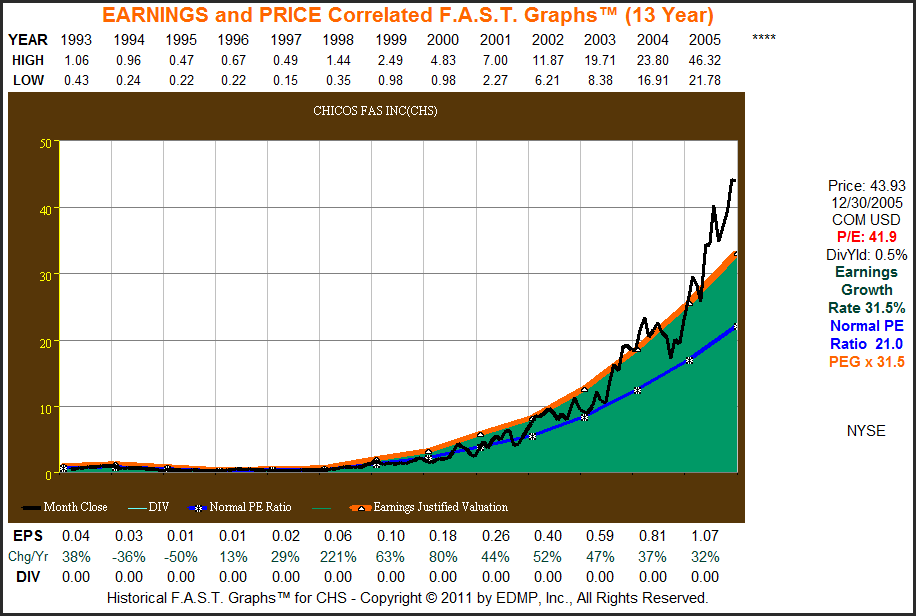
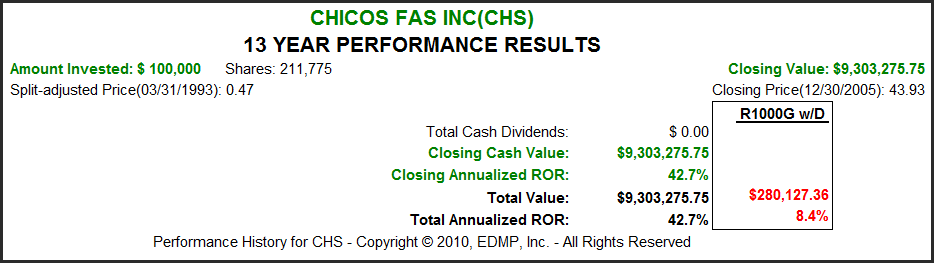
The following example of an extremely successful and fast-growing apparel retailer casts a light on the potential dangers that investors face with growth stocks. The company is Chico's FAS Inc.(CHS), and from the F.A.S.T. Graphs below you can see that this company had an extraordinary record of earnings growth and shareholder results from 1993 to 2005. Price and earnings correlated very nicely; however, by 2005 the company's stock price was overvalued based on my definition of fair value.
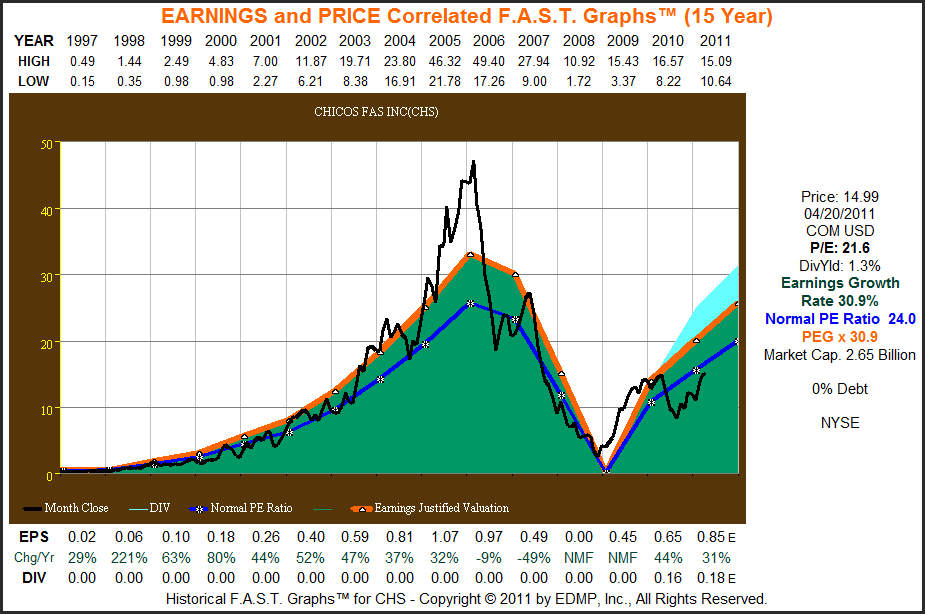
I might add, and be stating the obvious, that this was an extremely popular stock from the late 1990s into calendar year 2005. I would also like to add that expectations for continued growth were also commonly held. However, everything changed abruptly when earnings began to falter in fiscal 2007 (early calendar year 2006). With the graph below we can see the dangers of overvaluation exasperated by the effects of poor business results. As an aside, I can remember being told by many people, including business associates, that I was missing this great company. Fortunately, it was the overvaluation that kept me from owning the stock.
The Power and Protection of Diversification
Throughout this series on “Going for Growth” I have shown numerous examples of true growth stocks that have lavishly rewarded their shareholders. In my last example, Chico's FAS, I showed the potential dangers that can also occur with growth stocks. However, I want to add that because the benefits of owning growth stocks can be so extraordinary when they succeed, I feel strongly that they should not be completely ignored. On the other hand, because they are so rare, I have always believed in owning a portfolio of true growth stocks that was diversified enough to protect capital, but concentrated enough to offer exceptional future returns.
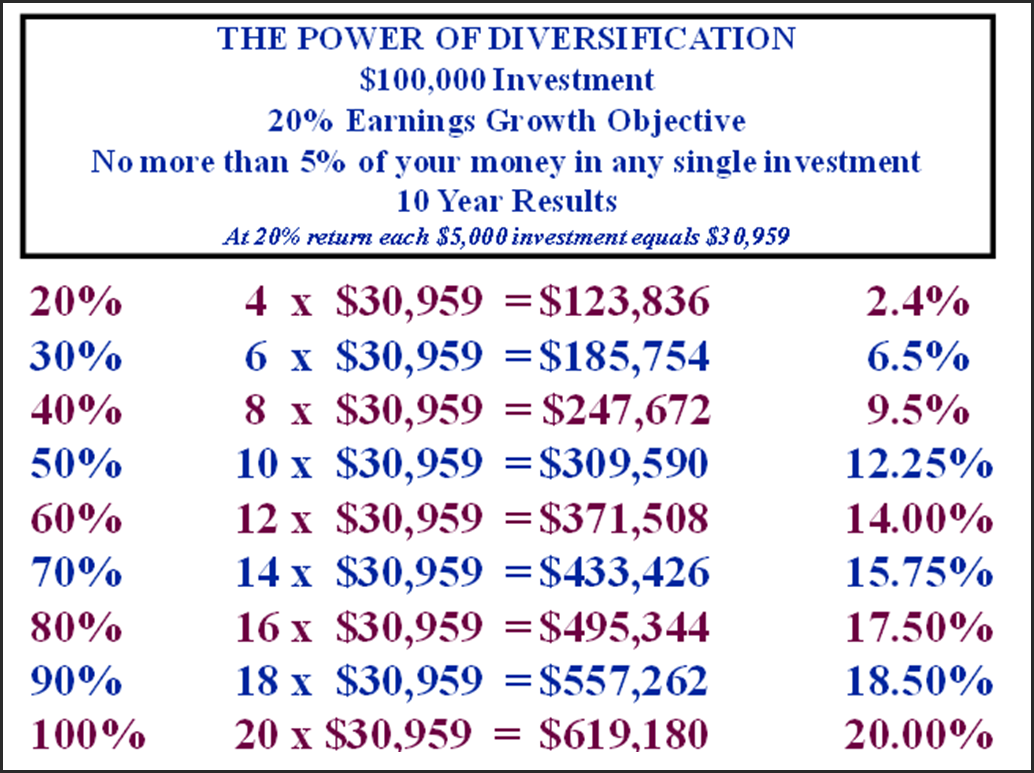
The following chart shows what I call the power and protection of a diversified portfolio of true growth stocks increasing earnings at 20% or above. This is merely a mathematical presentation, and perhaps extreme oversimplification of real world potentials. On the other hand, the math tells a very interesting story. Due to the power of compounding, the true growth stock capable of generating earnings growth of 20% or better can provide an extraordinary rate of return. The chart below shows what would happen at various percentages of success and failure. For example, if only 20%, or 4 companies in the 20 stock portfolio achieved their goals, and the other 16 companies were total failures (prices went to zero) mathematically your portfolio would still achieve a positive, albeit mediocre rate of return.
On the other hand, if only half of your companies succeeded (50%) and the other half failed, your long term return would still be exceptional. In the real world, events would probably never happen like the chart depicts. Even the Chico's example above did not go to zero. What the math is really telling us is how powerful just getting a few true growth stocks right can be.
Conclusions
As I have attempted to illustrate with this three-part series on “Going for Growth”, the rewards for investing in this equity class can be quite substantial and exciting. Conversely, the risks of investing in this equity class can also be high and/or severe. But most importantly, I hope I have shown that there are sensible and prudent ways to participate in this dynamic category while simultaneously mitigating risks to reasonable levels. This asset class is not for everybody, and does require a great deal of diligent monitoring. There are no shortcuts or easy methods, in my opinion.
I also believe that the same can be said of investing in any asset class, to include blue-chip dividend growth stocks. One of the things that attract many investors to the dividend category is the consistency and persistence of their historical records of both earnings growth and dividend growth (Dividend Champions, Aristocrats, etc.). This is the same concept that has attracted me to the true high-growth stock category. This is why I have always included a few blue-chip moderate dividend paying growth stocks within my portfolio of more aggressive true growth stocks. Total return and the power of compounding are important concepts that I believe every investor should consider and understand. Finally, note the stocks in this series are offered as recommendations to buy or sell. As I've already stated, I leave that decision to the discretion of each individual investor.
Disclosure: I am long GOOG, COH, KSS, BWLD, DECK.

Going for Growth: A Methodical Approach to Identifying Growth Stocks - Seeking Alpha

Going for Growth: A Methodical Approach to Identifying Growth Stocks - Seeking Alpha

My last article provided a historical analysis of how performance is generated, and which equity class, dividend paying stocks versus non-dividend paying stocks, produced the best performance historically. The article stimulated many thought-provoking comments and ideas to include a challenge to address the issue of how investors could identify and select true growth stocks going forward and not just by the rearview mirror. If you missed the article, and are interested, the following link will lead you to it. Want to Seek 'Significant' Alpha? Look Beyond Dividend Stocks
Introductory Positioning Statements
Before I go on, I want to clearly establish that the method of selecting and identifying growth stocks for above-average potential return is a method that I use and am comfortable with. It should be no surprise to regular readers of my work, that a lot of my methodology is assisted by the utilization of our F.A.S.T. Graphs™ (Fundamentals Analyzer Software Tool), which has been developed and evolved over the past four decades. On the other hand, we developed this "powerful tool to think with" in order to assist us in conducting what we consider to be essential preliminary research. We believe that our tool provides "essential fundamentals at a glance," which almost instantly enables us to determine the quality of the company being graphed, and how well it's been managed. For investors who don't have the advantage of our tool, the same work can be done through other sources of information, just not as easily.
But most importantly, I want to be clear that I am not arrogant enough to state that this is the best or only way to get the job done. However, I do consider the process that follows to be an intelligent and practical approach. I offer this strategy in the spirit of articles “as pointing the way to becoming a better investor” as fellow Seeking Alpha author David Van Knapp so eloquently described it in one of his comments on the article cited above. The reader is free to agree or disagree, offer suggestions and modifications, and accept or reject any or all of the process to their liking. But in the end, I am hopeful that what follows can change the perspective that I find many investors have regarding the risk associated with investing in growth stocks.
The benefits and rewards of owning and investing in true growth stocks can be extraordinary, but unquestionably the risks can be high. On the other hand, I intend to illustrate strategies that can mitigate the risks of investing in true growth stocks to a manageable and reasonable level. Diversification across various companies and industry sectors represents a key element of risk control. Consistency of the companies’ operating history is an attribute that we covet, which I believe also speaks to risk management. The level of debt a company has is an example of other quality characteristics that I feel must be exceptional before taking the risk of investing in a high-growth stock. Also, the individual investor's perspective on price volatility, how they look at it, and how they deal with it, can have a huge bearing on perceived risk versus real risk.
An essential component of our process relates to historical perspective, which we like to refer to as "learning from the past." However, I believe the most important component, and the most difficult one to execute, deals with forecasting future earnings. My approach is predicated on the fact and principle that forecasting future earnings and cash flows is the key to long-term investing success, for all equity asset classes, but applies most significantly to investing in true growth stocks.
It all starts with an achievable goal
I've long held and believe that a successful long-term investing strategy needs to start by establishing an achievable goal. For a goal to be achievable, it needs to be realistically based on real-world objectives. Although I believe in evaluating history, and taking advantage of the opportunity by learning from the past, I don't believe in looking back too far. In other words, I feel that more modern history, for example, the last 15 to 20 years, is a more relevant, and therefore, adequate time period to look back on. The growth rate of earnings for the average company, as measured by the S&P 500 (SPY) since 1992, has been 9.4% per annum. Since 1997, the average earnings per share growth rate of the S&P 500 has been approximately 6%. Therefore, I feel that 6% to 10% earnings growth represents a good proxy for a reasonable range of average earnings growth. (Note that I am not referring to stock market price performance here, only earnings or business growth).
Since I base my entire investing rationale upon the undeniable fact that earnings and cash flow determine market price and dividend income in the long run, then an understanding of normal or average earnings growth establishes a relevant baseline from which to establish future return goals. My thesis is that if you buy a business (stock) at a sound valuation, then earnings growth and long-term returns will closely correlate. I feel it makes no sense to engage in the amount of work and effort necessary to conduct effective research if your goal is to only do average. If it’s only average you seek, then the arguments favoring investing in index funds would apply.
But, since 6% to 10% represents average growth, my first criteria is to identify quality businesses that I believe not only have grown faster than that in the past, but most importantly are capable of growing faster than that in the future. Therefore, my foundational criteria for finding true growth stocks, is to screen for growing businesses that have grown earnings at an above-average rate of 15% per year or better, over a minimum timeframe of at least 3 to 5 years, but preferably 10 years or more.
I do not like to invest too early because of high risk, but I want to be early enough to participate in an achievable above-average growth cycle. The 15% or better goal is not merely pulled out of my hat, 15% or better is a number that years of research has shown to be achievable. In other words, there are numerous examples of companies that have achieved that level of growth over long periods of time, sometimes spanning decades or more. (As an interesting aside, the gap between 10%-15% is where most blue-chip dividend growth stocks can be found).
My goal for growth stocks, which I believe to be achievable, based on what has been stated regarding average, is for a total portfolio return objective of 15% to 20% or better. However, the specific goal that I apply to the component of true growth stocks is for 20% or better. I expect to achieve this number through a blend of companies achieving different growth phases. For example, there are 15% growers that also pay dividends, typically in the 1% to 2% range, where the growth yield over a market cycle, combined with a capital appreciation component, can help me get to the 20% number. These moderately high growers will be blended with very fast growers of 25% or better, where no dividend is being paid. This is also another way in which risk can be mitigated. Blending very high-growth with moderate growth that may even pay a dividend.
There were many comments expressed in my last article, and many other articles by yours truly and other authors, which spoke to the prudence of a diversified portfolio. In my personal case I am willing to commit 30% to 40% of my total portfolio to true growth stocks. For others this may be too high an allocation, but it suits me. The more conservative among you, may well limit your exposure to true growth stocks to 20% or 10%, or even none. The choice is personal, and should be based on your own appetite for risk, desire for return, and perhaps most importantly, willingness to work hard at continuing research.
Individual Stock Selection Criteria-Screening for Growth Candidates
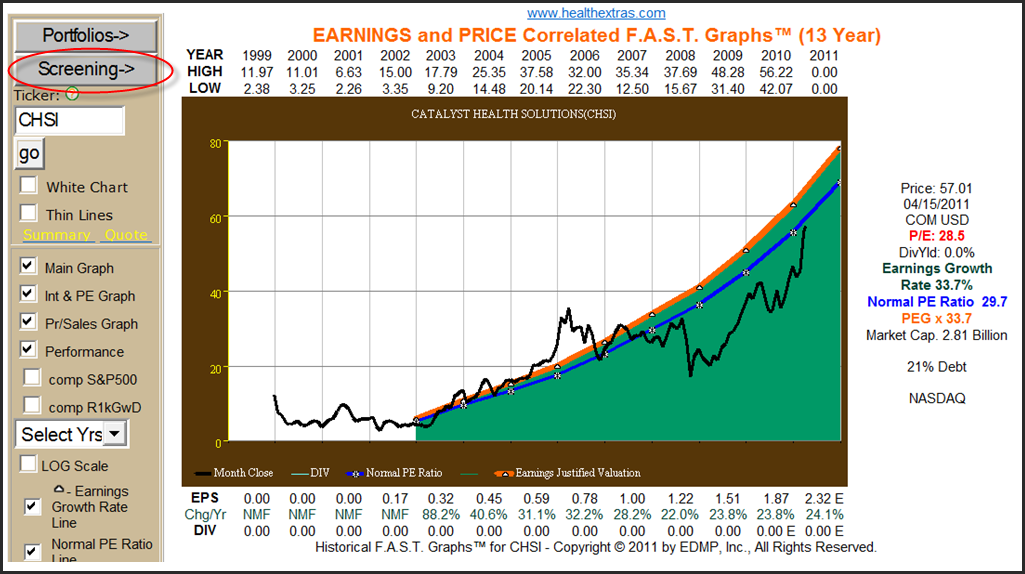
The first step in my approach to identifying potential high-growth candidates is to go to our research tool, which offers a screening function. The screenshot below illustrates the gray screen button (red circle) at the top left where this function is found. By clicking on that button I get a prompt that allows me to input criteria that I am searching for.
(Click charts to expand)
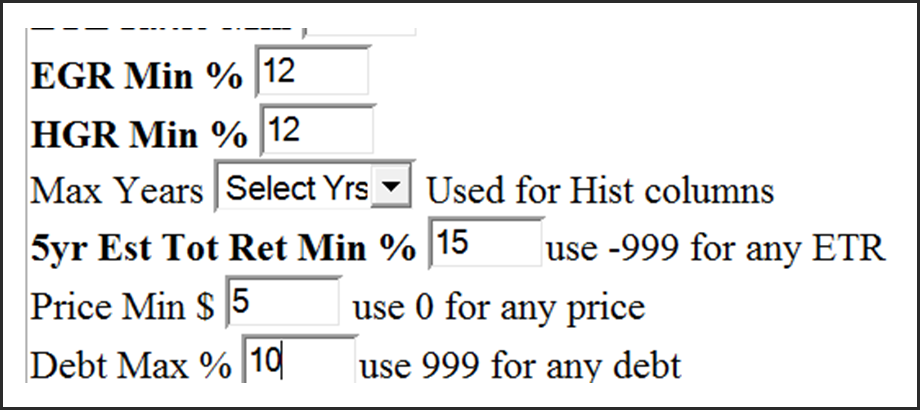
Below is a partial screenshot that is prompting me to input some of the key items I look for when searching for true growth stocks. In the example below, notice that I have asked the software to search for estimated earnings growth (EGR Min %) of 12% minimum, historical earnings growth (HGR Min %) of 12% and a five-year estimated total return minimum % of 15. I input returns slightly below my minimum 15% expectation in order not to exclude stocks based on data issues. In this example I've also looked for a minimum stock price of five dollars (no penny stocks) and a maximum debt level of 10%.
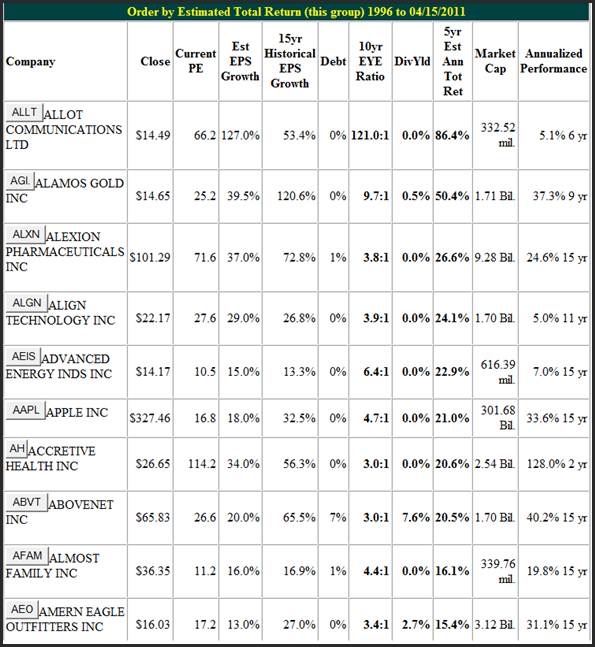
This first screen covered approximately 1,500 of the more than 16,000 available symbols. I simply keep hitting the screen button until the total data base is exhausted. This first go round produced the following example list of 10 possible candidates. At this stage, this is not a list of companies that I will actually consider for further research. The actual candidates that I'm willing to research further, require one additional filter that I consider mandatory. Even though this screen has given me exactly what I asked for statistically, this list also illustrates what I consider to be a major flaw or blind spot of statistics. As you will see, when I dig deeper, I find that some of these candidates do not fit my criteria for consistency.
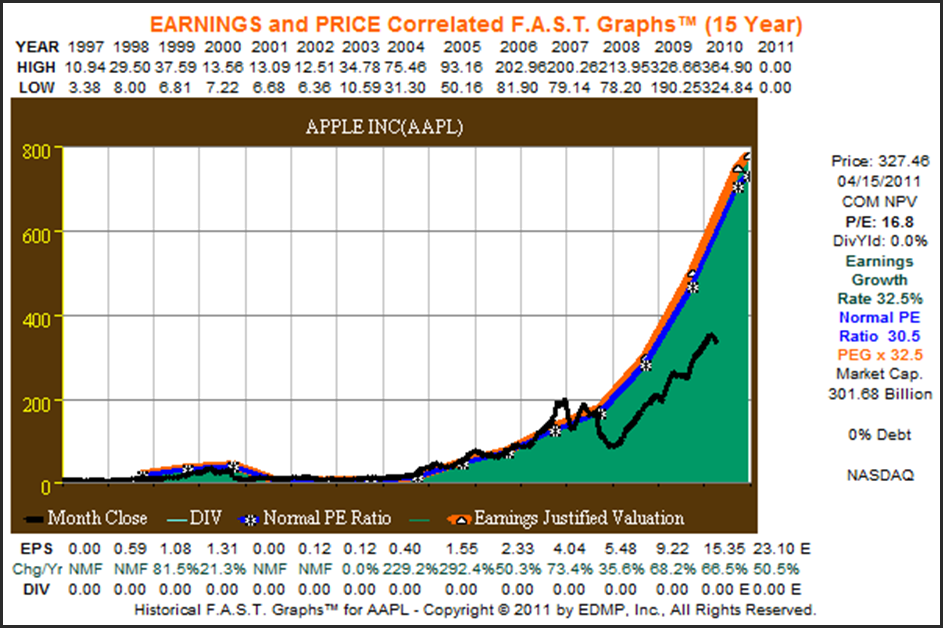
The next step in my process is to click on the first symbol on the list and draw a graph, which gives me a picture providing an instant determination whether I want to include the company in my further research, or not. I continue to produce a graph on each company on this first screen rejecting the ones that don't meet my criteria for consistency, and adding the ones that do, to a portfolio list for further study. The two examples listed below do not meet the criteria for the following reasons:
Allot Communications Ltd. (ALLT) does not possess a long enough history of consistent growth. I would require at least two more years of consistent earnings growth before I would consider further research.


Advanced Energy Industries Inc. (AEIS) has a long enough history, and technically earnings growth that met my search criteria of 12% or better. However, the high cyclicality of their historical earnings record cause this candidate to be rejected.
Apple Inc. (AAPL) becomes the first candidate from this first list of 10 that meet the criteria for further study, and it is added to the prospect list. You can see from the graph, Apple's earnings have been very consistent since calendar year 2001.

Building the Research List
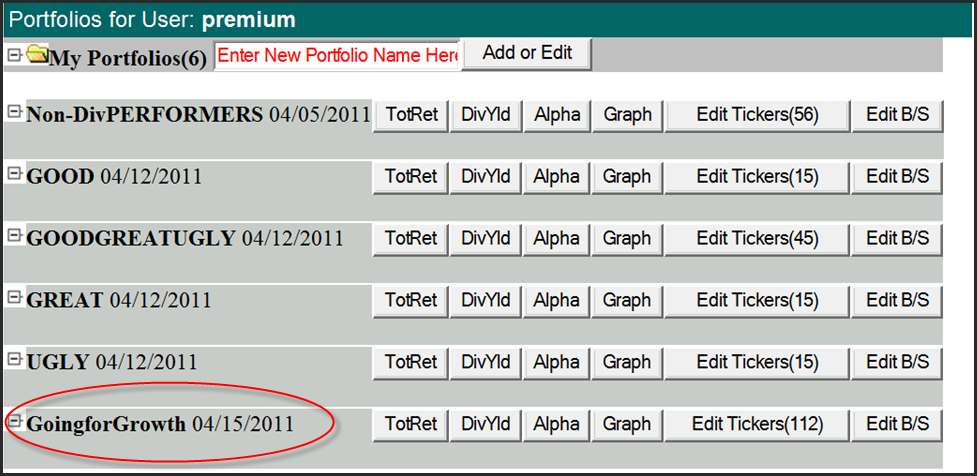
When I have completed this process I start over by raising the debt limit to 20%, then 30%, etc., up to 50% maximum. After going through this process until I have exhausted all the symbols of our database up to my maximum debt limit, I have created a “GoingforGrowth” (red circle) research portfolio list of 112 companies as seen below. (Note that the other portfolios on this list of portfolios were created for the previous article linked at the beginning of this one). Importantly, this is still not a list of companies that I would be willing to buy. Instead, it represents a list of companies that I'm willing to research deeper.
Conclusions (Part 1)
In part one of Going for Growth, I focused on selection criteria for prospective candidates based solely on historical earnings growth and other fundamentals. It's very important to state that valuation and price have not entered the equation at this stage of the process. However, these are extremely important components that must be at attractive levels before investment would ever be made. On the other hand, companies that meet all the criteria except fair value would be continuously monitored and reconsidered, if and when, price came into attractive valuation at some future time.
In part 2, my focus will move to looking to the future, and specific candidates will be reviewed. This will be where a clearer perspective of the features and benefits of true growth stocks will come to light. Although, as I have previously stated, historical perspective is an extremely important part of the selection process, it is only the first of many steps. Furthermore, since you can never invest in the past, but only in the future, forecasting future potential is the key. In part two we look to the future.
>> Continue to Part II
Disclosure: I am long CHSI.

Disclaimer: The opinions in this document are for informational and educational purposes only and should not be construed as a recommendation to buy or sell the stocks mentioned or to solicit transactions or clients. Past performance of the companies discussed may not continue and the companies may not achieve the earnings growth as predicted. The information in this document is believed to be accurate, but under no circumstances should a person act upon the information contained within. We do not recommend that anyone act upon any investment information without first consulting an investment advisor as to the suitability of such investments for his specific situation.